
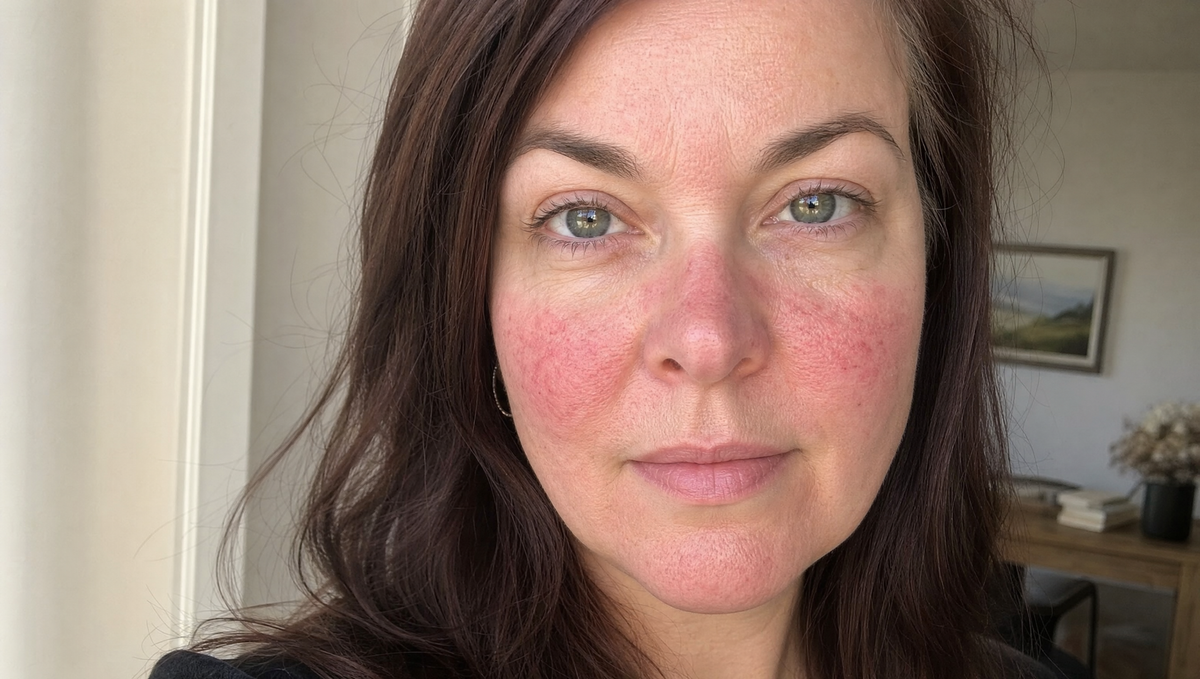
Rosacea and Redness in Irish Skin: What Helps in Autumn and Winter
You know the walk from the car to the front door. Four minutes, sideways rain, wind coming off nowhere in particular. You get inside, the heating's been on since six, and within about ninety seconds your cheeks are burning.
That deep, sitting-under-the-skin heat that stays long after the coat's off.
And you know the other versions of it too.
One glass of red at dinner and you can feel your face going before you've finished it. The curry you love and pay for the next morning. The week your inbox is on fire and your skin decides to join in - always the week you have something on. The hot coffee at your desk. The gym, forty minutes in. Sitting too close to the fire on a Sunday. Getting off a plane.
If any of that is your September through March - or your whole year - this one's for you.
It's not just you
Rosacea is common here in Ireland. The HSE puts it at around one in ten people in Ireland — it's so frequently seen in fair, Celtic skin that it's earned the nickname "the curse of the Celts."
So if you have pale, reactive, easily-flushed skin and you're Irish, you're genuinely in a higher-risk group, and you didn't cause this by just using the wrong products.
Worth saying too: rosacea occurs in every skin tone. It's just routinely missed in deeper skin, where redness reads differently. Persistent facial heat, swelling or bumps deserve the same attention regardless of your skin tone.
What's actually happening
Three things are running at once:
Your blood vessels overreact. They dilate too easily and take too long to settle. That's the flushing. Over years, some stop retracting fully, which is where the fine visible threads on the cheeks and nose come from.
Your immune system is on an extremely sensitive trigger. Rosacea-prone skin produces unusually high levels of an inflammatory protein called cathelicidin. In plain terms: your skin treats ordinary things — weather, a new cleanser, a glass of red — as threats, and reacts out of all proportion.
Your barrier is leakier and compromised. Most people miss this part. Research consistently shows rosacea-prone skin loses more water through the surface and holds less moisture than healthy skin. It also let's more irritants in and causes inflammation and stinging
That last one starts a loop that goes something like this:
Barrier weakens → skin loses water → your irritation threshold drops → things that never bothered you start to sting → stinging is inflammation → the barrier weakens further.
Round and round until you do something about it
What sets it off
The most-quoted trigger data comes from a survey of over a thousand people with rosacea. It's self-reported, so read it as directional — but it maps closely to what walks through the clinic door here.
- Sun — 81%. Still the number one trigger, and it doesn't stop in November. UVA passes through cloud and glass. Dropping SPF at the end of August removes your most protective daily habit at exactly the wrong moment.
- Stress — 79%. Not something you can moisturise away, but worth knowing it's on the list.
- Wind — 57%, rising to 88% in their winter-specific survey. This is Ireland's headline trigger. Not cold, wind. It strips moisture from the skin faster than almost anything, and we get it horizontally for six months.
- The temperature swing. Cold weather (46%) and indoor heat (41%) aren't really two triggers. You go from 6°C and wet to 22°C and bone-dry several times a day. That's the burning face at the kitchen counter.
- Your skincare — 41%. Four in ten people name their own products. This is the one you fully control, and usually the fastest fix.
- Honourable mentions: hot baths (51%), spicy food (45%), hot drinks (36%). We're not asking you to give any of them up, just noting the tea and the flare are related.
How to manage it
The instinct when skin goes red and sore is to do more — add an acid for the texture, a strong active for the tone. On reactive skin that nearly always makes it worse.
The goal is to make your skin harder to provoke.
Strip your routine back first. Cleanse, hydrate, protect with gentle ingredients for two weeks and see where your skin actually sits without external triggers from products
Fix the cleanse. Lukewarm water, never hot. A cream, milk or gel cleanser with no fragrance. Pat dry. If your face feels tight or irritated afterwards, the cleanser is too harsh — that's always a good test
Support the barrier daily. This is the entire game in winter. Ceramides, niacinamide, panthenol, squalane, glycerin, fatty acids.
Keep SPF on all year. Mineral filters — zinc oxide, titanium dioxide — tend to suit reactive skin better.
Pull your scarf over your cheeks. Unglamorous, and it does more on a wind day than most serums.
Avoid: fragrance and essential oils in leave-on products, menthol, camphor, witch hazel, alcohol denat., grainy scrubs, stacking acids on inflamed skin, and adding three new products at once so you can't tell which one caused the reaction.
What would we reach for in terms of products?
Cleansers
- Dermaviduals Cleansing Milk with DMS — no surfactants, no emulsifiers, no fragrance. Closest thing to cleansing with a moisturiser. For skin that stings at everything.
- Ultraceuticals Ultra Calming Cleanser — ultra-mild, non-foaming cream. Made for reactive and post-treatment skin. Very short ingredient list.
- AlumierMD SensiCalm — pH-balanced cream cleanser with niacinamide and ceramides. Does a bit of barrier work while it cleanses.
Serums
- Ultraceuticals Ultra R.E.D. Corrective Serum — niacinamide, zinc gluconate, ascorbyl glucoside, Tasmanian berry. Fragrance-free. The redness-specific pick.
- AlumierMD Calm-R — piperonyl glucose, poria cocos, hinokitiol. Lightweight, targets the look of redness and irritation.
- Ultraceuticals Ultra B² Hydrating Serum — niacinamide and hyaluronic acid, nothing to react to. For skin that's more dehydrated than red.
Moisturisers
- Dermaviduals DMS Base Cream High Classic — phosphatidylcholine, ceramides, shea, squalane, no emulsifiers. Dermaviduals list redness reduction among its benefits. For dehydrated and sensitive.
- Dermaviduals DMS Base Cream High Classic Plus — same as above, plus olive oil and CM glucan. The winter one, for very dry skin.
- Dermaviduals DMS Base Cream Classic — lighter version, for oily skin that's also red.
- Ultraceuticals Ultra Calming Moisturiser Cream — ceramides, prebiotics, phytosterols, niacinamide. Positioned specifically for discomfort after wind and heat exposure.
- AlumierMD HydraCalm — poria cocos, boswellia, ceramides, copper peptide. The richest of the three. Start here if skin is sore, not just red.
SPF
- AlumierMD Clear Shield — mineral filters, formulated for reactive skin.
When it's more than sensitivity
The honest part: skincare can't treat rosacea. It can support your barrier, help you tolerate the seasons, and reduce the appearance of redness. It isn't medicine, and we won't pretend otherwise.
Rosacea is a medical diagnosis, and there are genuinely effective prescription treatments, plus laser and light options for persistent visible vessels. See your GP if you have redness that's persistent rather than flaring and settling, bumps or pustules, thread veins that aren't fading, gritty or irritated eyes alongside facial redness, or any thickening of the skin around the nose.
A diagnosis doesn't replace your routine. The prescription treats the condition; the routine keeps your barrier strong enough to tolerate it.
Not sure which one you're dealing with?
That's what the free skin assessment is for. Our skin experts review every one personally and comes back with a straight read on what your skin needs — and she'll tell you plainly if what you're describing needs a doctor rather than a serum.
Start your free skin assessment →
General information, not medical advice. If you think you have rosacea, please see your GP.
Read more

If you've ever stood in front of a shelf full of serums — retinol, retinal, tretinoin, vitamin A — and had no idea which one was actually right for you, you're not alone. It's one of the most confu...

As the air outside gets colder and drier, and the heating goes on indoors, the skin barrier is working harder than it was in July. Here's what's actually going on, and what to do about it. What's A...